Prediction Markets: What are They? | A Step-by-Step Guide for Beginners
If you’ve spent any time on Kenyan social media lately, you’ve likely seen the heated debates over the Majembe vs. Mbavu Destroyer bout. While some are just arguing, others are using prediction markets to analyze the probabilities of the event.
But what exactly are prediction markets, and how do you get started?
What is a Prediction Market?
At its core, a prediction market is a platform where people trade "contracts" based on the outcome of future events. Think of it as a stock market, but instead of buying shares in a company, you’re buying shares in a "Yes" or "No" outcome of a real-world event.
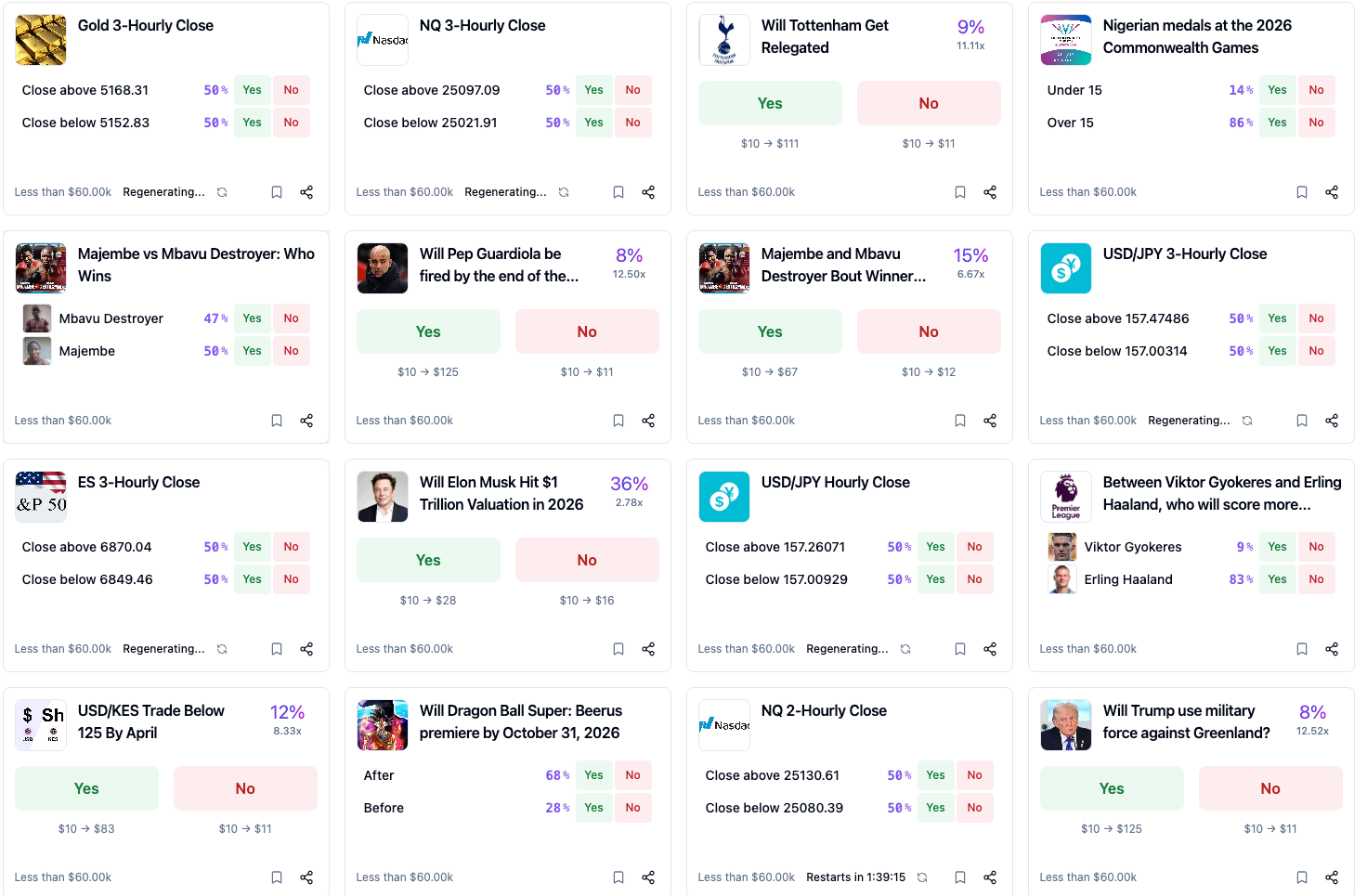
Types of Markets on a Prediction Markets platform
There are two main ways to trade:
- Binary Markets: These are the simplest. It’s a "Yes" or "No" question. “Will the Central Bank of Kenya raise interest rates this month?” You pick one.
- Multi-Asset Markets: These are for complex events. Instead of one market for the whole event, you have separate "Yes/No" options for each possible outcome. You can buy a "Yes" contract on Mbavu or a "No" contract on Majembe.
How Multi-Asset Markets Actually Increase Your Chances
In a Multi-Asset market, "Hedging" is a risk-management technique used to limit potential losses. Because each outcome is a separate contract, a trader can hold positions in multiple outcomes at once.
- Diversification: A trader might hold a "Yes" position on a specific player (eg; Mbavu the destroyer) while also holding a "Yes" position on the opponent (Majembe). If the bout ends in a draw, the first contract settles at $0, but the second settles at $1.00, potentially offsetting the loss.
- The Goal: The purpose of hedging is not to guarantee a win, but to ensure that an unexpected result doesn't result in a total loss of the initial capital. It allows the trader to define exactly which risks they are willing to take.
Math: From Cents to Dollars
Contracts are priced as cents
- Price = Probability: If a "Yes" contract for a Majembe win is priced at 0.65 cents, the market believes there is a 65% chance he will win.
- The Payout: Every winning contract pays out exactly $1.00.
The Strategy: If you buy 10 Yes contracts of Mbavu at $0.60, and he wins, your contracts are now worth $1.00 each, totaling $10.00.
If he loses, the contracts go to zero. The "volatility" (how much the price moves) depends on market demand which is influenced by the news—like a video of Mbavu training with a professional coach—which might drive his "Yes" price from $0.60 to $0.80 as more people buy Yes contracts.
Are Prediction Markets the same as Gambling?
No. While they feel similar, the regulatory world views them differently:
- Sports Betting: Regulated locally as gambling.
- Prediction Markets: Regulated as event contracts by financial bodies (like the CFTC globally or the CMA in Kenya).
In Kenya, the Virtual Asset Service Providers (VASP) Act of 2025 has brought these platforms under the supervision of the Capital Markets Authority, offering a transparent, data-driven alternative to traditional betting.
Managing Your Risk: How Not to Lose Your Shirt
- The 2% Rule: Never put more than 2% of your total balance on one event.
- Understand "The Resolution Criteria": Read the rules. Does the market pay out on a technicality or only an official decision?
- Liquidity Matters: Stick to high-volume markets so you can sell your contracts easily if you change your mind.
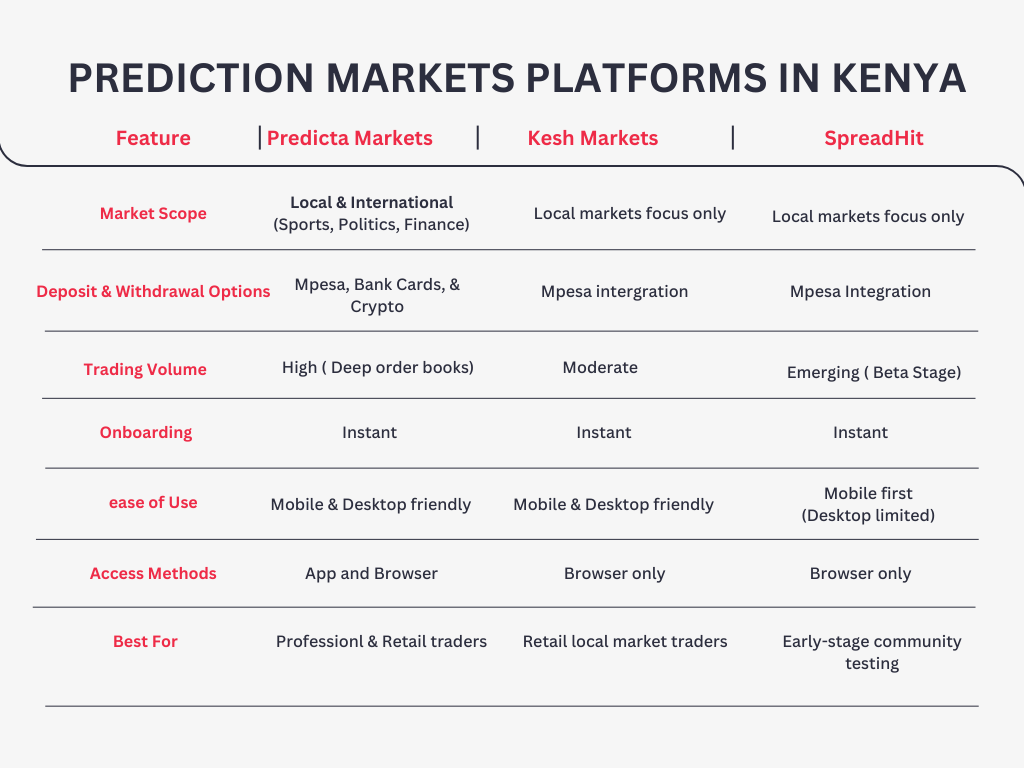
Which Prediction Markets Platform should you use in Kenya?
Disclosures:
This blog is provided for informational and educational purposes only and does not constitute financial, investment, or legal advice.
Prediction markets involve significant risk, and prices can be highly volatile.
Past performance or "market accuracy" is not a guarantee of future results.