Africa's Forests Are Now Emitting More Carbon Than They Absorb — And It's Repricing Everything From Carbon Credits to Gold
Africa's forests now emit more carbon than they absorb — a reversal threatening billions in carbon credits and repricing Gold as COP31 approaches. Trade the outcome on Predicta prediction markets.
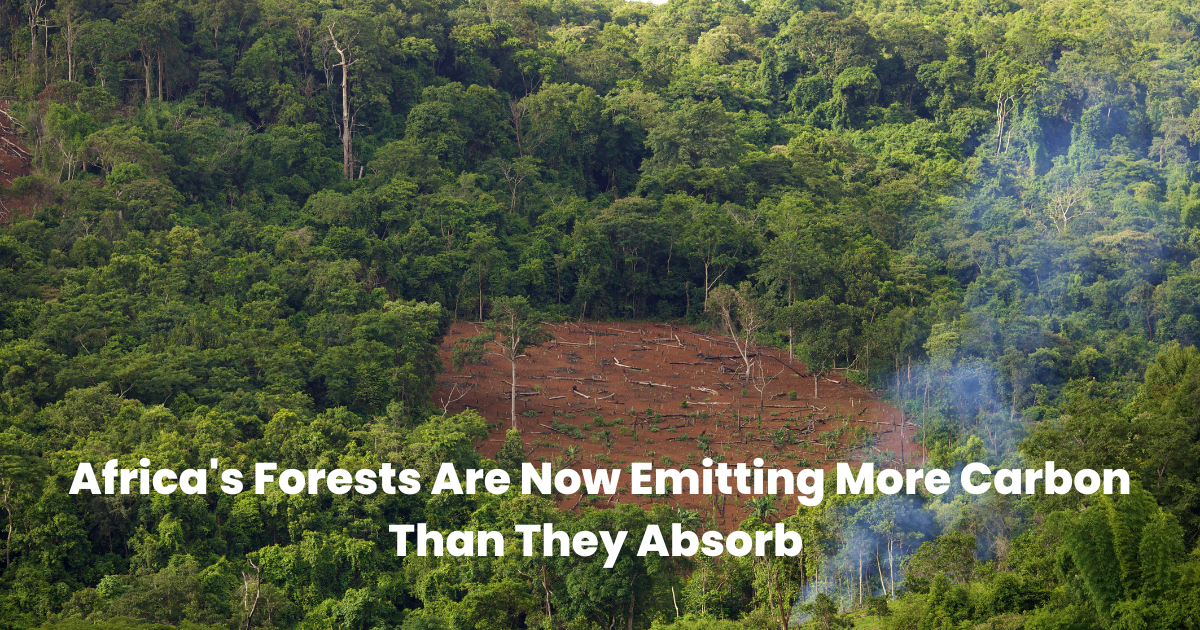
The voluntary carbon market is pricing African forest credits as if the continent still absorbs carbon — it doesn't, and it hasn't since 2010. A study published in Nature Scientific Reports confirms that deforestation flipped Africa's forests from carbon sink to carbon source over a decade ago, yet the $2.29 billion voluntary carbon credit market is still growing at 21.5% annually on the assumption that African forestry offsets work (Sustainable Stories Africa). That's a valuation built on a physical reality that no longer exists.
For Gold traders in Lagos, Nairobi, and Johannesburg, this isn't abstract environmentalism. It's a repricing catalyst.
Africa Stopped Being a Carbon Sink in 2010 — The World Just Noticed
Researchers using satellite biomass data found that Africa gained carbon between 2007 and 2010, but heavy deforestation in tropical moist broadleaf forests tipped the balance permanently after that (The Guardian). The losses from forest clearing far outweigh any carbon gains from regrowth (ScienceDaily).
The Nature paper is blunt: Africa's forests and woody savannas "historically acted as a carbon sink, removing atmospheric carbon and storing it as biomass" — past tense (Nature).
That past tense is doing billions of dollars of work. REDD+ programmes across the Congo Basin, East Africa, and West Africa have been issuing forest carbon credits on the premise that standing forests are net absorbers. If the continent is a net emitter, those credits don't offset what they claim to offset.
The COP31 Collision Course
COP31 is the next major political test of whether recent climate commitments translate into real adaptation finance (COP31). Africa's negotiating leverage at these summits has always rested partly on a simple trade: we protect forests that absorb your emissions, you fund our development.
That trade just lost its scientific foundation.
Now add a credibility gap — the continent's forest carbon maths don't add up — and the negotiation dynamic shifts.
Two outcomes are in play. Either carbon credit prices for African forestry projects collapse as buyers question additionality, or REDD+ funding dramatically increases to reverse the deforestation driving the flip. Both paths reprice risk. Neither is priced in.
What This Does to Gold
Climate uncertainty drives safe-haven demand — that's not speculation, it's mechanism. When carbon credit frameworks face credibility shocks, the downstream effects ripple through commodity markets and currency hedging strategies across the continent.
Meanwhile, African central banks — Nigeria, South Africa, Ghana — are accumulating Gold reserves. They're hedging macro uncertainty that their own forests are now accelerating. Your central bank is buying the asset you trade, for the same reason this story matters.
Trade the uncertainty. Predicta gives you $10 to start — no deposit required. → predictamarkets.com
The Political Fallout Is the Tradeable Event
Kenya's 2027 election is already a live question. Climate policy, carbon credit revenue, and international funding flows are not abstract issues for Kenyan voters — they're budget lines. The UDA-ODM coalition question is a proxy for whether Kenya's political class consolidates around a climate-finance platform or fractures.
The market currently says 35% probability UDA and ODM field a unified presidential candidate in 2027. That feels low if carbon credit revenue collapses and both parties need a joint platform to negotiate COP31 outcomes. It feels right if the coalition can't survive the blame game over deforestation policy failures.
Which side are you on? Think Kenyan politics will reprice alongside its forests? → Trade it now
Got a sharper angle on African climate markets? Create your own market on Predicta and earn from every position taken. Your analysis is worth money — prove it.